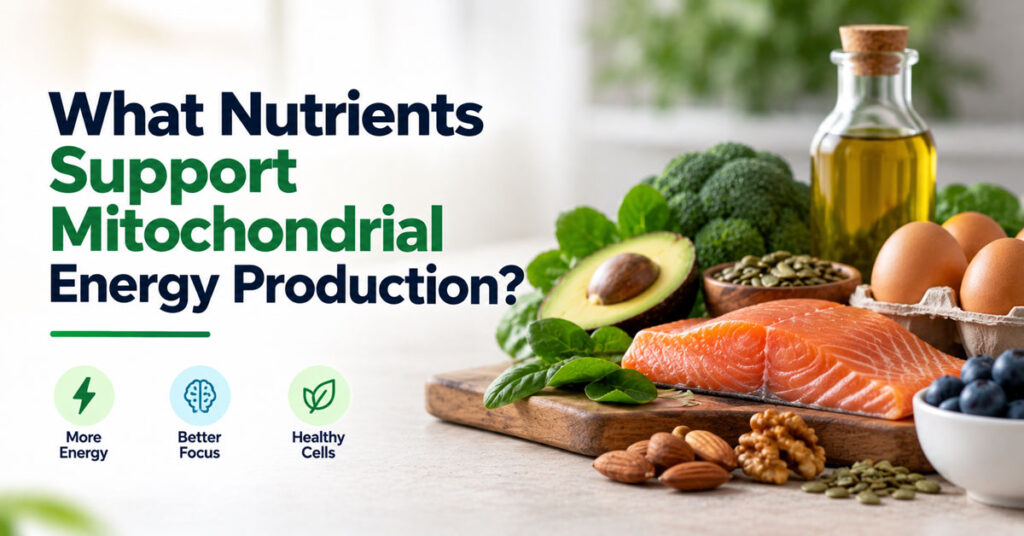
What nutrients support mitochondrial energy production? Several vitamins, minerals, amino acids, and plant compounds play important roles in the cellular pathways that help mitochondria produce ATP. While no single nutrient is a magic solution for energy, getting enough of the right nutrients provides the raw materials mitochondria need to function normally.
Mitochondria are often described as the body’s cellular powerhouses, but the process is more complicated than that phrase suggests. They use nutrients from food through a series of metabolic reactions to generate ATP, which cells use for everyday activities. Nutrition, exercise, sleep, and overall health can all influence this process.
Why Nutrients Matter for Mitochondrial Energy
Mitochondrial energy production depends on numerous enzymes, cofactors, and molecules working together. Some nutrients help enzymes carry out metabolic reactions, while others participate directly in pathways that transfer electrons or create ATP.
This is why nutritional deficiencies can interfere with normal energy metabolism. However, taking extra amounts of a nutrient does not necessarily mean mitochondria will produce more energy. For most people, the goal should be adequate nutrition rather than simply taking the highest possible dose.
Key Nutrients That Support Mitochondrial Energy Production
| Nutrient | Role in Energy Metabolism | Common Food Sources |
|---|---|---|
| Niacinamide / Vitamin B3 | Helps form NAD, which participates in energy metabolism | Poultry, fish, meat, fortified grains |
| Riboflavin / Vitamin B2 | Forms FAD and FMN used in energy-producing reactions | Eggs, dairy, meat, almonds |
| Magnesium | Supports ATP-related reactions and enzyme activity | Nuts, seeds, legumes, whole grains |
| CoQ10 | Transfers electrons within the mitochondrial respiratory chain | Meat, fish, some vegetables |
| Iron | Important for proteins involved in cellular respiration | Meat, seafood, beans, fortified foods |
| L-Carnitine | Helps transport fatty acids into mitochondria | Red meat, dairy, fish |
| Alpha-Lipoic Acid | Acts as a cofactor for mitochondrial enzyme complexes | Organ meats, spinach, broccoli |
1. Vitamin B3 and NAD
Vitamin B3 is particularly interesting when discussing mitochondrial energy because it is used to make NAD, or nicotinamide adenine dinucleotide. NAD participates in redox reactions that help cells extract energy from carbohydrates, fats, and proteins.
Niacinamide, also called nicotinamide, is one form of vitamin B3. It is found in foods and is also used in some supplements. Rather than thinking of NAD as a direct energy supplement, it is more accurate to view it as an important molecule involved in the chemical reactions that make cellular energy possible.
2. Riboflavin (Vitamin B2)
Riboflavin is another B vitamin with a direct connection to cellular energy metabolism. The body converts it into two coenzymes called FAD and FMN. These molecules participate in numerous metabolic reactions, including processes associated with mitochondrial energy production.
Foods such as eggs, dairy products, lean meats, and some nuts can contribute to dietary riboflavin intake. Because B vitamins work together in metabolism, maintaining adequate intake of the entire group is generally more useful than focusing on one vitamin in isolation.
3. Magnesium
Magnesium is involved in hundreds of biochemical reactions throughout the body. It has an important relationship with ATP because cellular ATP commonly exists in association with magnesium. The mineral also supports the activity of numerous enzymes involved in metabolism.
Good dietary sources include pumpkin seeds, almonds, beans, whole grains, and leafy green vegetables. People who do not consume enough magnesium through their diet may have difficulty meeting their nutritional needs, but high-dose supplementation is not automatically better and can cause digestive problems.
4. Coenzyme Q10
Coenzyme Q10, commonly known as CoQ10, is naturally found in mitochondria. One of its key roles is helping transfer electrons through the electron transport chain, a series of reactions involved in producing ATP.
CoQ10 also functions as an antioxidant. The body can produce CoQ10, and smaller amounts are available from foods such as meat and fish. It is frequently included in mitochondrial support supplements because its biochemical role is closely connected to the mitochondrial energy-producing system.
5. Iron
Iron is essential for several proteins involved in cellular respiration. Within mitochondria, iron-containing proteins help with electron transfer and other metabolic reactions that contribute to energy production.
Dietary sources include meat, seafood, beans, lentils, spinach, and iron-fortified foods. However, iron is an important example of why supplementation should be approached carefully. Taking additional iron without a demonstrated need is not a good general strategy, and excessive iron can be harmful.
6. L-Carnitine
L-carnitine is an amino-acid-derived compound involved in transporting long-chain fatty acids into mitochondria. Once inside the mitochondria, these fatty acids can enter pathways that help generate energy.
The body can make carnitine, and dietary sources include red meat, fish, and dairy products. Acetyl-L-carnitine is a related form commonly found in supplements. Research has examined different forms of carnitine for various purposes, but their effects can depend on the individual and the specific outcome being studied.
7. Alpha-Lipoic Acid
Alpha-lipoic acid is a naturally occurring compound that acts as a cofactor for several important enzyme complexes. Some of these enzyme systems operate within mitochondria and help convert nutrients into usable energy.
Alpha-lipoic acid is also known for its antioxidant activity. Supplements may contain standard alpha-lipoic acid or specifically identify the R-alpha-lipoic acid form. When comparing products, checking the exact form and amount on the Supplement Facts label can make it easier to understand what the formula actually provides.
8. D-Ribose
D-ribose is a five-carbon sugar that forms part of the structure of important cellular molecules, including components of ATP. Because ATP is the primary energy-transfer molecule used by cells, D-ribose has attracted interest in research involving cellular energy.
D-ribose should not be confused with a stimulant. It does not work like caffeine or an energy drink. Instead, it is a building block used in cellular chemistry. It appears in some mitochondrial formulations alongside nutrients that participate more directly in energy metabolism.
9. PQQ
Pyrroloquinoline quinone, or PQQ, is a compound that has attracted attention for its potential effects on cellular signaling and antioxidant systems. Research has explored its relationship with mitochondrial biology, including pathways associated with mitochondrial adaptation.
Interest in PQQ has grown, but the human evidence is not as extensive as it is for established nutrients such as magnesium or B vitamins. For that reason, PQQ is better viewed as an emerging ingredient rather than a proven shortcut to higher energy levels.
10. Curcumin and Other Plant Compounds
Curcumin, the best-known group of compounds in turmeric, is frequently included in mitochondrial support formulas because of its antioxidant and cellular-signaling properties. Oxidative processes are naturally connected with mitochondrial metabolism, making antioxidant research relevant to the broader conversation about cellular health.
Other plant compounds, including quercetin and resveratrol, have also been studied for their potential effects on cellular signaling and mitochondrial biology. Much of this research is still developing, so supplement claims should be kept proportional to the available evidence.
Food First: Where Should You Get These Nutrients?
Before considering supplements, it makes sense to look at the overall diet. A varied eating pattern can provide many of the vitamins, minerals, amino acids, and plant compounds involved in energy metabolism.
| Food Group | Examples | Relevant Nutrients |
|---|---|---|
| Leafy greens | Spinach, kale, broccoli | Magnesium, folate, antioxidants |
| Nuts and seeds | Almonds, pumpkin seeds, walnuts | Magnesium, healthy fats, minerals |
| Fish and seafood | Salmon, sardines, shellfish | Protein, B vitamins, minerals |
| Lean meats | Chicken, beef, turkey | B vitamins, iron, carnitine |
| Whole grains and legumes | Oats, lentils, beans | B vitamins, magnesium, minerals |
Can Supplements Provide Additional Mitochondrial Support?
They can be useful when dietary intake is inadequate or when a particular nutritional need has been identified. Some mitochondrial support supplements take a broader approach by combining several nutrients involved in energy metabolism rather than relying on one ingredient.
However, the presence of an ingredient does not guarantee a noticeable benefit. Quality, dosage, individual nutritional status, diet, lifestyle, and overall health all matter. A supplement should therefore be evaluated as part of the bigger picture rather than treated as a replacement for healthy habits.
Looking for a Multi-Ingredient Mitochondrial Formula?
Advanced Mitochondrial Formula combines several nutrients discussed in this article, including niacinamide, magnesium, CoQ10, acetyl-L-carnitine, R-alpha-lipoic acid, D-ribose, PQQ, curcumin, quercetin, and resveratrol. You can review the complete formula and ingredient amounts to see whether this type of nutritional approach fits your goals.
See Advanced Mitochondrial Formula
What Else Supports Mitochondrial Energy?
Nutrients are only one piece of mitochondrial health. Regular physical activity is particularly relevant because exercise can stimulate adaptations in skeletal muscle mitochondria. Adequate sleep and a balanced diet also provide the foundation for normal energy metabolism.
It is also worth paying attention to persistent or unexplained changes in energy. Feeling tired can have many possible causes, and supplements are not an appropriate substitute for identifying an underlying health issue. If low energy continues or interferes with daily activities, discussing it with a healthcare professional is a sensible next step.
How to Choose a Mitochondrial Supplement
If you decide to compare mitochondrial supplements, start with the Supplement Facts panel. Look for clearly listed ingredients and amounts rather than relying on broad claims about “energy” or “cellular power.” A transparent label makes it much easier to compare one product with another.
Also consider what you are already taking. Several products may contain overlapping nutrients, which can unintentionally increase your total intake. If you take medications, have a health condition, or are considering higher-dose supplementation, talk with a qualified healthcare professional before adding a new formula.
Final Thoughts
Mitochondrial energy production relies on a remarkably interconnected network of nutrients and biochemical reactions. Vitamin B3, riboflavin, magnesium, CoQ10, iron, L-carnitine, alpha-lipoic acid, and D-ribose all have important roles in energy-related pathways, while compounds such as PQQ, curcumin, quercetin, and resveratrol are being studied for additional cellular effects.
The most practical approach is not to chase a single “energy-boosting” ingredient. Instead, focus on a nutritious diet, regular movement, sufficient sleep, and appropriate supplementation when there is a good reason to use it. Understanding what each ingredient actually does can help you make a more informed decision when comparing mitochondrial support supplements.